
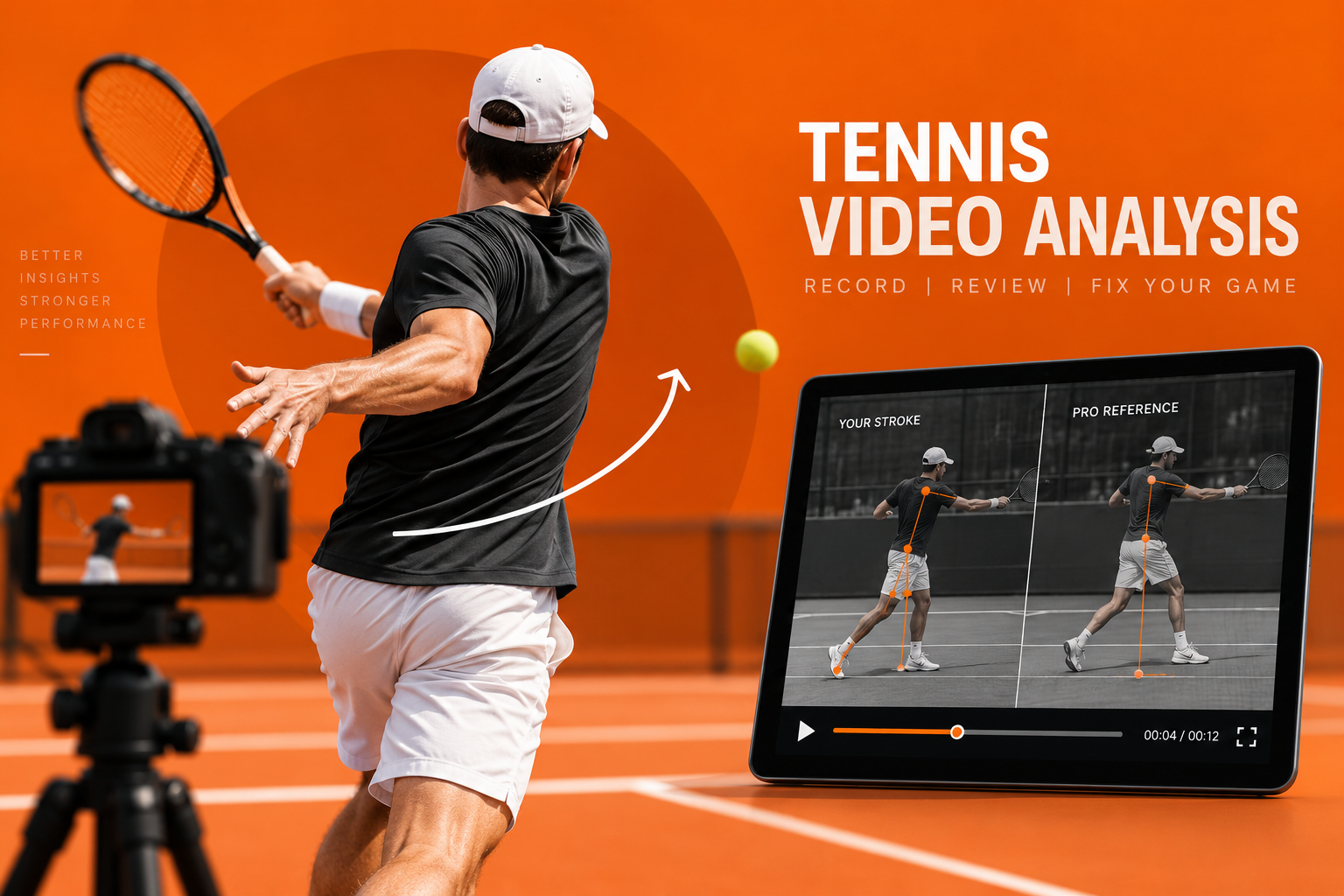
If you have ever finished a match convinced your forehand felt off but couldn’t explain why, you already know the limit of relying on feel alone. The body lies. It tells you your racquet was on time when it was late, that your weight shifted forward when it actually stayed on your back foot. Tennis video analysis exists to close that gap between what you think you did and what you actually did.
This guide walks through what tennis video analysis really means, why it works better than verbal coaching on its own, exactly how to record usable footage, what a proper frame-by-frame breakdown looks for, and how often you should be doing this if you are serious about improving. If you want to see what a real breakdown looks like rather than just read about one, you can watch a sample technical analysis before you keep reading.
What Is Tennis Video Analysis?
Tennis video analysis is the process of recording a player’s strokes and movement on court, then reviewing that footage, often frame by frame, to identify the technical, tactical, and physical patterns behind their performance. It is not the same as rewatching a match to relive the highlights. It is a diagnostic process, closer to what a physiotherapist does with a gait analysis than what a fan does replaying a great point.
The difference matters. Watching a match tells you the score. Technical video analysis tells you why the score happened. A coach trained in this kind of review isn’t just watching whether the ball went in. They are watching grip changes at the moment of contact, hip and shoulder rotation sequencing, the split step timing before a shot, and how all of that compares to a professional player with a similar build and playing style. In our own coaching process, we break every stroke down into nine key dynamic positions from preparation to recovery, then measure a player’s actual movement against what that same moment looks like in a pro player of a comparable profile. That comparison is where the real coaching value sits, not in the video itself.
If you want to see how this looks as a structured course rather than a one-off review, our technical video analysis programs are built around exactly this process.
Why Tennis Video Analysis Works Better Than Verbal Coaching Alone
Video analysis works because it removes the two biggest weaknesses in normal on-court feedback: memory and self-perception. A coach can tell you ten times that your racquet drops too late on your serve. Until you see it happen on screen, next to a pro serving the same shot, it usually doesn’t fully land.
This isn’t just coaching folklore. Research on video feedback and motor learning backs it up directly. A peer-reviewed study on intermediate tennis players found that giving players some control over when they reviewed their own footage, rather than reviewing on a fixed external schedule, produced better learning of tactical skills. Separate reviews of video feedback research across sport and physical education settings have consistently found that seeing expert performance alongside your own movement helps players self-correct more effectively than verbal feedback on its own (see sources below).
In plain terms: watching yourself, ideally next to a reference model, and having some agency in how you review it, produces faster and more durable technical change than being told what you’re doing wrong. That’s the entire logic behind structured tennis training videos rather than casual filming.
A few concrete reasons this approach outperforms verbal-only coaching:
- It closes the gap between intention and actual movement, since players consistently misjudge what their own body is doing mid-rally.
- It allows direct, side-by-side comparison with a professional player of a similar height, build, and style, rather than a generic technical model that doesn’t fit the player’s body.
- It creates a dated visual record, so progress across a season is provable rather than anecdotal.
- It removes memory bias. A coach’s verbal note from three weeks ago fades. A video clip doesn’t.
How to Record Tennis Videos for Technical Analysis
Good analysis starts with good footage. A blurry, badly angled video makes even an experienced coach’s job harder and can lead to the wrong conclusion entirely. Here is the short version: film from the side and from directly behind the baseline, use the highest frame rate your device supports, keep the whole body in frame from setup to follow-through, and film full points rather than only isolated shadow swings.
Here is the fuller breakdown.
1. Camera position and angle. For most strokes, you want two angles if possible: side-on (perpendicular to the baseline, capturing the full swing path and body rotation) and behind the baseline, roughly in line with the center service line, to capture footwork, spacing, and contact point relative to the body. A single angle is fine to start, but side-on is the priority for stroke mechanics.
2. Frame rate and resolution. Most modern phones can film at 60 frames per second or higher, and some support slow motion at 120 or 240 fps. Higher frame rates matter because a tennis swing happens fast; a standard 30fps video can blur or skip over the exact moment of contact, which is often the single most diagnostic frame in the whole stroke.
3. Distance and height. Position the camera far enough back to capture the full body plus a bit of court context, at roughly waist to chest height on a tripod or fixed surface. Handheld footage that shakes or drifts is one of the most common reasons a video becomes unusable for frame-by-frame review.
4. Lighting and court conditions. Film with the light behind the camera, not behind the player, and avoid strong backlighting that turns the player into a silhouette. Indoor courts with even lighting are usually easier to analyse than outdoor courts at midday with hard shadows.
5. Full rallies versus isolated repetitions. Both have a place. Isolated repetitions (shadow swings or fed balls) are useful for a clean look at technique in a controlled setting. Full rally or match footage is essential for seeing how that technique holds up under time pressure, fatigue, and real ball variation, which is usually where the more revealing faults show up.
6. Organising your footage. Name your clips by date and stroke type, and keep a simple folder structure. This sounds minor, but when you’re tracking technical changes over months, being able to instantly pull up “forehand, March” next to “forehand, June” is what makes progress visible instead of just felt.
What a Frame-by-Frame Technical Analysis Actually Breaks Down
Once the footage is filmed, the real work starts. A proper frame by frame review isn’t about spotting one obvious flaw and stopping there. It’s a structured pass through the entire kinetic chain, from the ground up, looking for where timing, posture, or sequencing breaks down relative to a matched pro model.
Here’s roughly how the common fault categories break down:
| Area | What a coach is looking for frame by frame |
| Grip | Whether the grip matches the intended shot (for example, an eastern versus semi-western forehand) and whether it shifts mid-swing without the player noticing |
| Contact point | Whether the ball is struck in front of the body, at the correct height, and in a consistent spot relative to the front foot |
| Kinetic chain timing | Whether the legs, hips, shoulders, and arm fire in the correct sequence, since power lost anywhere in that chain usually shows up as an arm-only swing |
| Footwork and split step | Whether the split step lands at the right moment relative to the opponent’s contact, and whether recovery steps put the player back in a ready position in time |
| Follow-through and balance | Whether the finish position leaves the player balanced and ready to move, or falling out of the shot, which often explains late recovery on the next ball |
This is also where comparison footage earns its keep. Watching a player’s contact point next to a professional of a similar build makes a two-inch timing error obvious in a way that a verbal description never quite manages.
Different players need different depths of review depending on their level and goals, which is why we structure this as tiered Bronze, Silver, and Gold technical video analysis options rather than one fixed package. A junior working on a single stroke needs a different scope of review than a competitive adult player troubleshooting a match-specific breakdown under pressure.
Common Mistakes Players Make When Filming or Reviewing Their Own Tennis Videos
Most players who try this on their own run into the same handful of problems.
- Wrong camera angle. Filming from behind the player, or too far off to the side, hides exactly the information you need (contact point, hip rotation, weight transfer).
- Only filming winners. It’s natural to want to film the shots that felt good. The misses and the break points are usually far more diagnostic.
- No comparison footage. Without a reference model, it’s hard to know whether a slightly unusual-looking swing is actually a flaw or just a stylistic variation that works fine for that player’s body type.
- Reviewing without a trained eye. Most players, understandably, don’t know what they’re looking at frame by frame. A flaw that looks like a wrist problem is often actually a hip timing issue two frames earlier in the swing.
- Ignoring the tactical and mental context. A technical breakdown on a big point often isn’t purely technical. Fatigue, anxiety, and shot selection under pressure all show up in the video too, and a full review should account for that, not just the swing shape in isolation.
Tennis Video Analysis for Coaches, Parents, and Academies
Video analysis scales differently once you’re coaching more than one player. A coach running a squad, or a parent coaching their own child, benefits from a structured, repeatable process rather than one-off, instinctive feedback, simply because it’s impossible to hold every player’s technical history in your head.
For parents and coaches specifically, having a consistent framework for reviewing and comparing footage over time also protects against a common trap: over-correcting a young player based on a single bad session rather than a genuine pattern across weeks of footage. Our coaching and mentoring program for parents and coaches is built specifically around this, helping the adults guiding a young player’s development build an individualized program rather than a one-size-fits-all template.
How Often Should You Do a Technical Video Analysis?
For a player in an active training block, every four to six weeks is a reasonable cadence for a full technical review. That’s frequent enough to catch a bad habit before it becomes ingrained, but far enough apart that you’re measuring a genuine pattern rather than reacting to one off day.
Around a deliberate technical change, such as adjusting a grip or reworking a serve motion, more frequent short check-ins, sometimes every one to two weeks, help confirm the change is actually sticking under match conditions rather than only showing up in isolated drilling. Across a full season, keeping dated footage in one place, rather than scattered across a phone’s camera roll, is what turns individual reviews into an actual progress record you can look back on.
The Bottom Line
You cannot fix what you cannot see, and most players simply cannot see their own technique clearly enough from the inside of the shot to correct it on feel alone. Tennis video analysis, done properly, with the right footage and a trained eye comparing it against a matched professional model, turns a vague sense that “something feels off” into a specific, fixable diagnosis.
If you’re ready to find out what your own footage actually shows, you can book a coaching session or enrol directly in one of our technical video analysis courses. And if you’d like to hear it from players who’ve already been through the process, our testimonials page has their results in their own words.
About the author: This guide was written from the coaching methodology used at MyTennisCloud, developed over 30+ years of coaching experience and built on certifications across physical, technical, tactical, and psychological performance training. Read more about the coaching philosophy behind MyTennisCloud.
Further reading and sources:
- ITF Coaching: Biomechanics and Technique resource centre, for coaches and researchers’ articles on stroke biomechanics.
- Self-Controlled Video Feedback Facilitates the Learning of Tactical Skills in Tennis, a peer-reviewed study on video feedback and tennis skill acquisition.
Frequently Asked Questions
What equipment do I need to start tennis video analysis? A smartphone capable of filming at 60 frames per second or higher and a simple tripod or fixed surface are enough to get started. A second angle, a wide-angle lens attachment, or a dedicated camera can improve quality, but they aren’t required for a useful first review.
How is technical video analysis different from a normal lesson? A normal lesson focuses on real-time correction and drilling during the session itself. Technical video analysis is a slower, more detailed diagnostic process, usually done after the session, that breaks the stroke down frame by frame and compares it against a matched professional model to identify the root cause of a pattern rather than just its symptom.
Can beginners benefit from tennis video analysis, or is it only for competitive players? Beginners often benefit the most, since early technical habits are easier to change before they become automatic. Video analysis at this stage tends to focus on grip, basic swing path, and footwork fundamentals rather than the finer timing details relevant to advanced players.
How long does a frame-by-frame review take? A single stroke review typically takes a coach anywhere from twenty minutes to an hour depending on how much footage is provided and how many angles are available. A fuller match or session review covering multiple strokes and movement patterns takes longer.
Can I submit tennis training videos remotely for online analysis? Yes. This is one of the main advantages of online technical analysis over an in-person lesson: footage can be filmed on your own court, uploaded, and reviewed by a coach remotely, which is exactly how our technical video analysis service works for players who don’t have access to specialised in-person coaching.